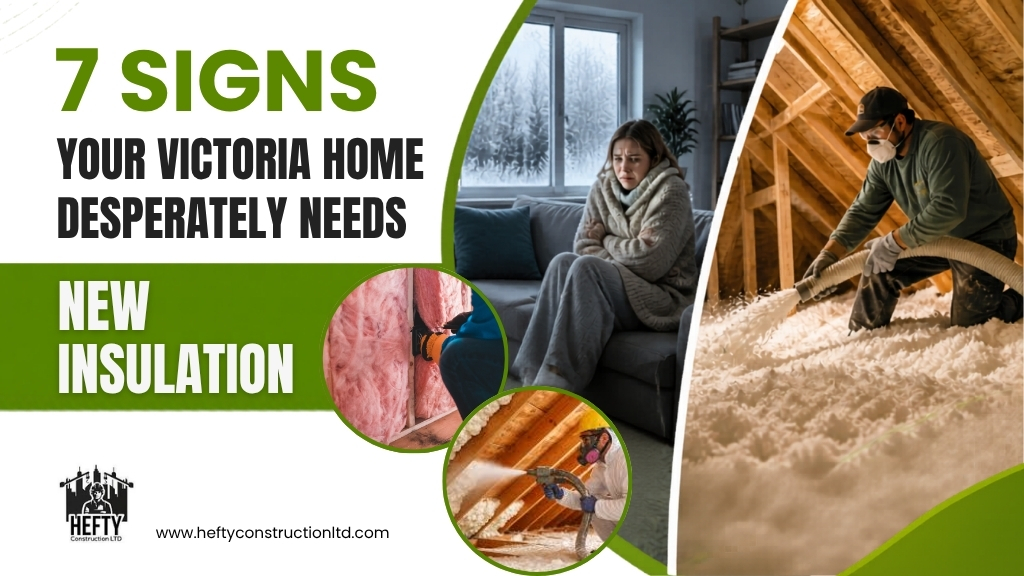
Your heating bill is up. One room stays cold. The house just never feels right.
Most Victoria homeowners blame the furnace or the windows. But the real culprit is usually the insulation.
Victoria’s climate is damp and cool all year. That’s hard on insulation over time. And when it starts failing, you don’t always notice right away. You just feel it – in your bills, your comfort, and your energy use.
If you’ve been looking into home insulation services in Victoria, these 7 signs will tell you whether your home actually needs attention.
Sign #1: Your Energy Bills Keep Going Up for No Obvious Reason

Pull out last year’s BC Hydro bills. Compare them to three years ago.
If they’ve been climbing and nothing else has changed – same appliances, same habits, same household – your insulation deserves serious attention.
This is usually the first sign. And the most ignored.
When insulation wears down, it stops holding heat inside. Your furnace or heat pump has to run longer to keep the temperature steady. You don’t notice anything dramatic. The house still gets warm eventually. But that equipment is working harder every single day, and you’re paying for it.
BC Hydro’s own data shows most homes save at least 10% on energy costs after an insulation upgrade. For older Victoria homes, the savings are often much higher than that.
Don’t call your utility provider first. Call the best insulation contractors. Chances are they’ll find the real answer quickly.
Sign #2: Some Rooms Are Comfortable and Others Never Quite Get There
Walk through your home on a cold morning. Really pay attention.
Does your spare room seem to belong in a separate house while your living room is cozy? Is it notably colder upstairs than below, or the opposite?
One of the most obvious indicators that insulation is deteriorating is uneven temperatures.
It’s not a heating issue. The entire house would sense it if it were. When a room or floor is consistently cooler than the others, it almost generally indicates that the insulation in that particular region has either deteriorated, been compacted, or was never placed correctly in the first place.
This is very common in Victoria homes built before 1990. Wall and floor insulation from that era compresses over time. It loses its ability to hold warmth. The room above a crawl space is a classic example – cold floors, cold air, and a heater that never quite catches up.
Sign #3: You Feel Drafts Inside and the Windows Are Shut
Close every window and door in your house. Wait a few minutes.
Now stand near an interior wall on a windy day. Do you feel a slight chill coming off it? A faint airflow that shouldn’t be there?
That’s not normal. And it’s not a window problem.
Indoor drafts almost always point to gaps in wall or attic insulation. Over time, especially in Victoria’s older housing stock, insulation shifts and shrinks. Small gaps open up. Cold air finds a path through.
Good insulation does two things: it slows heat transfer and it blocks air movement. When one starts failing, the other usually follows shortly after. If you’re feeling drafts that have nothing to do with windows or doors, the issue is almost certainly behind your walls.
Sign #4: Your Walls or Floors Feel Cold and Slightly Damp to the Touch
This is the sign most Victoria homeowners completely miss. It’s also one of the most important.
Go to an exterior wall in your home. Not near a window. Just a plain stretch of wall. Press your hand flat against it.
Does it feel noticeably cold? Even a little clammy?
In a properly insulated home, interior walls should feel close to room temperature. If they feel cold to the touch, your insulation isn’t doing enough to separate the warm air inside from the cold and damp outside.
Now add Victoria’s coastal humidity to that equation. Moisture in the air starts working its way into under-insulated walls. Over months and years, that creates the exact conditions mould needs to grow and mould is a health issue, not just a comfort one.
A musty smell in a room with no obvious source is the next thing to notice after cold walls. That combination – cold, damp, musty – is a clear signal that something needs attention before it becomes a far more expensive problem.
Sign #5: Your Home Takes Ages to Warm Up and Cools Down Too Fast
Turn on the heat first thing in the morning. Are you still uncomfortable after two hours?
Or it warms up perfectly, but within an hour the furnace turns off and it becomes frigid once more.
A house with enough insulation warms up quite rapidly and maintains that temperature for several hours. Once heat enters, the insulation functions as a thermos, retaining it.
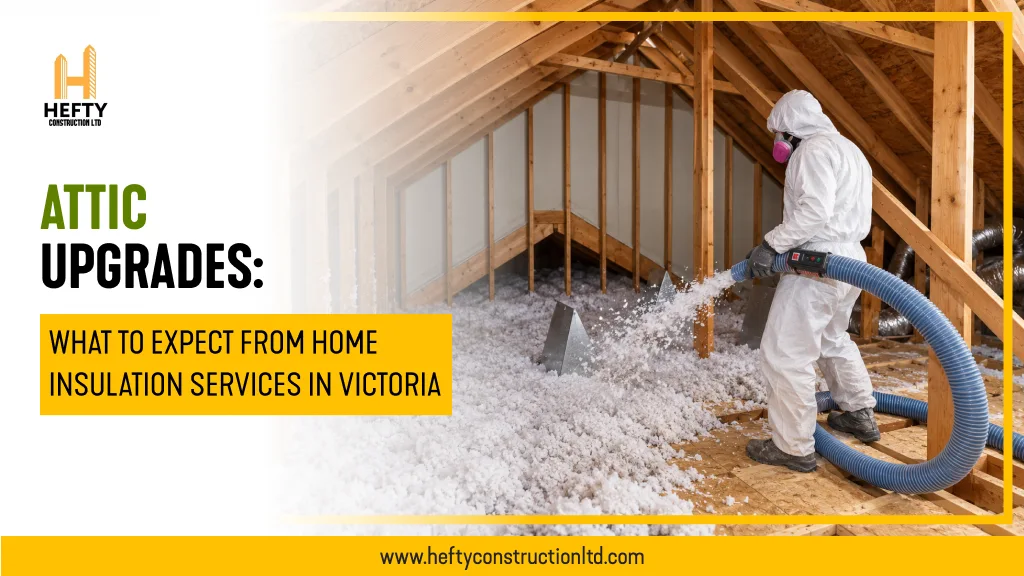
Your home’s insulation isn’t holding onto heat properly if it heats slowly and cools quickly. For attics in particular, this is true. Heat rises, and if the insulation in your attic has been compacted or settled over time, heat is leaking through your home’s roof. Your heating system runs longer cycles. It uses more energy. And you’re still cold.
This is one of the most common things we find during assessments. The attic is almost always the biggest culprit and often the most cost-effective place to start.
Our home insulation services in Victoria include a full thermal assessment of your attic, walls, and crawl space. We find where the heat is going. Then we tell you exactly what needs to change – honestly, in plain English, without pushing you toward work you don’t need.
Sign #6: Frost or Ice Sits Unevenly on Your Roof After a Cold Snap
This one surprises people. But it happens in Victoria more than you’d expect.
Step outdoors and take a look at your roof after a night below freezing. Is the ice or frost melting in some places while remaining frosty in others? Does the location of the roof’s warm and cold spots follow a distinct pattern?
Heat escaping from your home through the attic is what’s causing that irregular pattern.
Heat rises through and heats the roof surface above in areas where attic insulation is inadequate or absent.
Frost melts there first. In colder climates this creates ice dams – frozen ridges along the roof edge that push water under shingles and cause leaks. Victoria doesn’t get as much of this as Alberta or Ontario, but during cold spells it absolutely happens.
If you’ve noticed uneven frost patterns, unusual ice along the roof edge, or any signs of water getting in near the eaves after cold weather – this is why. And the fix is almost never the roof itself. It’s the insulation below it.
Sign #7: Your Home Is Over 20 Years Old and Insulation Has Never Been Assessed
This might be the most straightforward sign on the list.
If your home was built before 2000 and nobody has ever looked at the insulation, not once, there’s a strong chance it’s underperforming. Not because it was installed badly, necessarily. Just because nothing lasts forever without some attention.
Fibreglass batts from the 1980s compress and settle. Blown-in cellulose shifts. Spray foam from older installations was often applied at lower standards than what’s used today. And many Victoria homes from the 1960s and 70s were built with very little insulation by modern standards – sometimes barely enough to meet the codes of that era, which were far below where we are now.
The good news: not every older home needs a complete overhaul. Sometimes a targeted top-up in the right spots, the attic especially, makes an enormous difference. The honest answer depends on what’s actually there.
Working with the best insulation contractors means getting a real assessment, not a sales pitch. At Hefty Construction, we’ve worked on over 1,500 buildings across the Greater Victoria area. We’ll tell you what we find and what we actually recommend and those two things aren’t always the same.
What to Do If You Spotted These Signs
Two or more of these sound familiar? Start with a professional assessment – not a quote.
There’s a difference. A real assessment looks at your attic, walls, floors, and crawl space. It tells you where the problem actually is before anyone mentions cost.
That’s how we work at Hefty Construction. We look at what’s there, tell you what we find, and give you a straight answer on what needs attention and what doesn’t.
We’re also registered with the CleanBC and BC Hydro rebate programs – which means we can help you access up to $5,500 in eligible upgrade costs. Income-qualified households can get 60–95% of costs covered. Most homeowners are surprised how accessible these programs are.
Frequently Asked Questions
Q1. How much do home insulation services in Victoria, BC cost?
Ans. It depends on the area and type of insulation. Attic work for a typical Victoria home runs between $1,500 and $4,000. Walls and crawl spaces cost more. The real number to focus on is your out-of-pocket cost after rebates – CleanBC and BC Hydro programs cover up to $5,500. Income-qualified households can get 60–95% covered. Always get a written quote first.
Q2. What type of insulation works best in Victoria’s climate?
Ans. Victoria’s damp air makes moisture resistance important. Spray foam works best for attics, crawl spaces, and rim joists. Blown-in cellulose or fibreglass suits attic top-ups well. Batt insulation is the go-to for walls. The right choice depends on your home. A good contractor assesses first and recommends second.
Q3. Can I get rebates for home insulation in BC?
Ans. Yes. The CleanBC Better Homes Energy Savings Program offers up to $5,500 for eligible upgrades. BC Hydro’s Home Renovation Rebate Program adds more on top. Income-qualified households can have 60–95% of costs covered. Work must be done by a registered contractor to qualify – so confirm that before you hire anyone.
Q4. How long does a home insulation upgrade take in Victoria?
Ans. Most attic jobs are done in a day. Crawl space and wall work takes one to two days depending on the home. You don’t need to vacate. Disruption is minimal. A good contractor gives you a clear timeline before starting and cleans up fully when done.
Q5. How do I find the best insulation contractors in Victoria, BC?
Ans. Check for a valid BC licence, liability insurance, and WorkSafeBC coverage. If rebates matter to you, confirm they’re registered with CleanBC and BC Hydro programs. Prioritise contractors with experience in older Victoria homes – pre-1980 builds have specific requirements most generalists miss. Ask for a written quote, check their references, and make sure they explain their recommendations clearly.