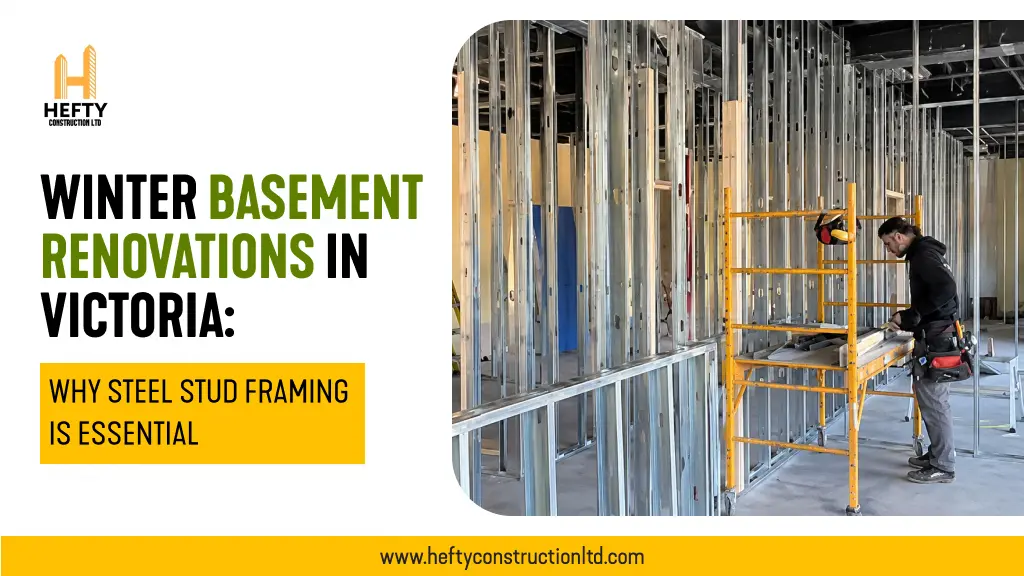
Winter in Greater Victoria brings a distinct set of challenges for homeowners. While the rest of Canada freezes under heavy snow, the Pacific Northwest experiences months of atmospheric rivers, sustained humidity, and damp concrete foundations. If you are planning to turn an unfinished basement into a cozy living room, home office, or secondary rental suite this season, your choice of wall framing material can make or break your investment.
While traditional lumber has long been the default building material, high-quality steel stud framing Victoria is quickly becoming the favourite for contractors and smart homeowners alike. Light-gauge steel framing completely eliminates the moisture-related headaches typical of coastal winter construction, giving you perfectly straight walls, superior mould protection, and a faster project timeline.
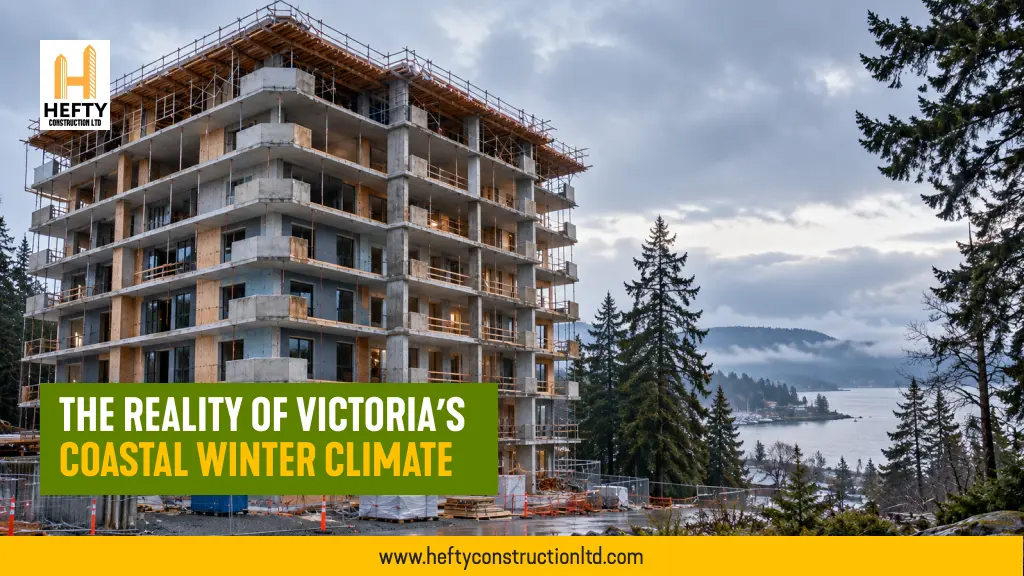
The Reality of Victoria’s Coastal Winter Climate
To understand why traditional materials struggle in subterranean spaces, you have to look closely at Victoria’s unique climate during the fall and winter months.
From November through March, relative humidity across Vancouver Island remains consistently high. Concrete basement walls and slab floors naturally draw in moisture from the surrounding wet soil through capillary action and vapour transmission. When warm interior air meets these cool concrete surfaces, condensation forms behind your framed walls.
If you frame a damp basement using traditional lumber during a damp coastal winter, several problems emerge:
- Warping and Twisting: Kiln-dried dimensional lumber acts like a sponge. As it absorbs ambient humidity on the job site, wooden 2x4s twist, bow, and cup. This leaves you with wavy drywall lines, cracked corner beads, and doors that won’t close properly.
- Mould and Organic Decay: Wood is an organic material. Combined with moisture, darkness, and limited airflow behind basement walls, framed lumber creates a fertile breeding ground for black mould and fungal decay.
- Structural Shrinkage: As your home’s heating system turns on for the winter, wet wood studs dry out unevenly, causing drywall fasteners to pop and seams to open up months after finishing.
By contrast, cold-formed galvanized steel framing is completely inorganic. It does not absorb moisture, swell, shrink, or support mould growth, making it uniquely suited for Victoria’s coastal winter conditions.
Key Benefits of Steel Stud Framing in Winter Basement Builds
Choosing professional steel stud framing services brings distinct performance advantages when finishing a lower-level living space in damp weather.
Steel Stud Framing vs. Traditional Wood Framing: Quick Comparison
| Feature | Steel Stud Framing | Traditional Wood Framing |
| Moisture Resistance | 100% Rust-Resistant & Waterproof | Absorbs Water, Warps & Rots |
| Mould & Mildew Growth | Inorganic (Cannot Host Mould) | Organic Material (Mould Source) |
| Wall Straightness | Laser-Straight Precision | Bows, Twists, & Shrinks Over Time |
| Fire Rating | Non-Combustible (Class A) | Combustible |
| Weight & Installation | Lightweight, Fast Assembly | Heavy, Requires Saws & Cleanup |
| Pest Resistance | Impervious to Insects & Rodents | Susceptible to Termites/Rot |
Superior Moisture Protection & Zero Mould Risk
Galvanized light-gauge steel framing is coated with a protective zinc layer that prevents rust and corrosion. Because steel contains no organic cellulose, mould spores simply cannot feed on it. Even if temporary condensation forms on concrete foundations prior to insulation sealing, steel studs retain their structural integrity without rotting or decaying.
Laser-Straight Walls for Flawless Drywall Finishes
Every steel stud is manufactured to exact dimensional tolerances. Unlike lumber, where tradespeople spend hours culling crooked boards, steel tracks and studs guarantee plumb corners and flat wall surfaces. This is critical for downstream finishing, ensuring your baseboards, custom cabinetry, kitchen backsplashes, and drywall tape joints fit cleanly without expensive scribe work.
Accelerated Winter Project Timelines
Winter daylight is short, and working outdoors in the rain slows down framing crews. Steel stud installation is extremely clean and fast:
- Studs are easily cut with snips or chop saws, producing zero sawdust or airborne mess inside your home.
- Pre-punched knockouts in metal studs allow electricians and plumbers to run wiring (using protective plastic grommets) and PEX piping through walls in a fraction of the time.
- Tracks are mechanically fastened directly to concrete floor slabs using powder-actuated fasteners or concrete screws with a thermal break gasket underneath.
Acoustic Performance and Soundproofing for Secondary Suites
With Victoria’s low vacancy rates and rising demand for legal secondary suites in neighbourhoods like Saanich, Langford, and Oak Bay, sound isolation between floors is essential. Steel studs are more flexible than rigid wood studs, meaning they act as a natural acoustic dampener. When combined with resilient channels, acoustic insulation batts, and sound-rated drywall, metal framing significantly increases the Sound Transmission Class (STC) rating of your interior partition walls, keeping noise from transferring between rental units.
Fire Safety and Code Compliance
Steel is inherently non-combustible. Utilizing metal framing adds an extra layer of fire protection to your home, which is vital when creating mechanical rooms, utility enclosures, or furnace rooms under basement stairwells.
Professional Standards for Winter Basement Steel Framing
Building a basement wall assembly in Greater Victoria’s damp climate requires precise, system-based installation techniques to ensure long-term durability and full compliance with the BC Building Code. When executing winter basement conversions, specialized contractors follow strict quality-control protocols:
- Thermal Break Integration: Because metal conducts heat, professional installation includes continuous XPS (extruded polystyrene) rigid insulation or spray foam barrier behind the steel studs to stop cold thermal bridging from exterior concrete walls.
- Moisture Barrier Gaskets: A specialized foam sill gasket is applied under all metal bottom tracks, completely isolating the galvanized steel framing from direct contact with raw, damp basement concrete slabs.
- Engineered Gauge Selection: Structural integrity depends on selecting the right steel gauge- using light 25-gauge studs for non-load-bearing partition walls, and reinforcing areas with heavy 20-gauge steel or wood backing where wall-mounted TVs, floating vanities, or heavy kitchen cabinetry will hang.
- Code-Compliant Electrical Protection: Precision snap-in grommets are installed in all pre-punched stud knockouts before running wiring, eliminating the risk of sharp metal edges damaging electrical insulation.
By working with an experienced local contractor, you guarantee that every thermal, acoustic, and structural detail of your steel stud framing in Victoria is handled to the highest industry standards.
The Verdict: A Smarter Investment for Victoria Homes
Investing in a basement renovation during winter is the fastest way to add livable square footage or launch a secondary suite before spring. In Victoria’s damp coastal climate, however, choosing traditional moisture-sensitive framing materials introduces severe long-term risks.
Partnering with Hefty Construction for specialized steel stud framing in Victoria safeguards your home against mould, eliminates structural warping, and delivers a rock-solid foundation for flawless drywall finishes. Our experienced local crews understand the BC Building Code requirements for thermal breaks, acoustic isolation, and moisture control inside subterranean spaces.
Whether you are building a legal rental suite in Colwood or a custom media room in Gordon Head, relying on our proven steel stud framing services gives you complete peace of mind that your winter renovation is built to last a lifetime.
Frequently Asked Questions
Q1. Is steel stud framing more expensive than traditional wood framing in Victoria?
Ans. While material costs fluctuate, steel stud framing is generally comparable in price to dimensional lumber. Because metal studs are lightweight, straight, and pre-punched for wiring, installation labour is often faster, offsetting any minor material differences. Furthermore, steel eliminates costly long-term callbacks for drywall cracking or mould remediation.
Q2. Can you hang heavy items like TVs and cabinets on steel stud walls?
Ans. Yes. For heavy items like wall-mounted televisions, kitchen cabinets, or floating vanities, contractors simply install wood backing, plywood blocking, or heavy-gauge steel backing plates inside the metal stud track before drywalling. Toggler-style snap-toggle anchors can also support significant loads directly in metal studs.
Q3. Are steel studs load-bearing for basement renovations?
Ans. While standard 25-gauge steel studs are designed for interior, non-load-bearing partition walls, heavy-gauge structural steel framing (such as 18-gauge or 16-gauge cold-formed steel) can be engineered to support structural loads if required by a design professional.
Q4. How do steel studs help with BC Building Code soundproofing requirements?
Ans. Steel studs are slightly more flexible than wood, which helps decouple drywall from the structural frame. When combined with mineral wool insulation and resilient channels, steel framing systems achieve higher STC (Sound Transmission Class) ratings, making it easier to meet BC Building Code requirements for legal secondary rental suites.
Q5. Can I install steel stud framing during a wet Victoria winter?
Ans. Absolutely. In fact, winter is the ideal time to use steel studs because they do not absorb moisture or warp while sitting on the job site. Unlike wood, which must be carefully stored and acclimated to avoid warping in damp weather, steel studs can be installed immediately regardless of outdoor humidity.